
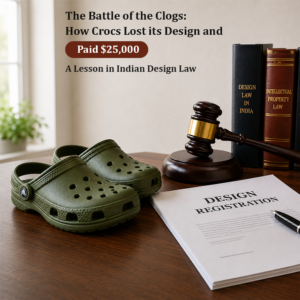
For over two decades, Crocs’ iconic perforated clogs have been recognised worldwide for their distinctive appearance. Their unique shape became synonymous with the brand, making them an obvious subject for IP protection.
Recently, in Crocs Inc. USA v. Bata India Ltd. [CS(COMM) 625/2018] the Delhi High Court directed Crocs to pay USD 25,812 (₹24.63 lakh) as litigation costs to Bata after its design infringement suit failed. While the dispute began with allegations that Bata had copied Crocs’ registered design, it ultimately reinforced two fundamental principles of design law in India: a registered design is only as strong as its novelty, and commercial litigation carries commercial consequences.
More Than Just a Pair of Clogs
Crocs instituted a suit alleging that Bata had infringed its registered design by manufacturing footwear that was an obvious imitation of its signature clog. The company sought a permanent injunction, damages, and other consequential reliefs. At the initial stage, Crocs secured an ex parte injunction, and Local Commissioners were appointed to seize the allegedly infringing footwear.
However, Bata shifted the focus of the dispute from whether its footwear resembled Crocs’ design to a more fundamental question, whether Crocs possessed a valid and enforceable design right in the first place.
Unlike patents, which protect inventions, the Designs Act 2000 protects only the visual appearance of an article. Under Section 2(d), a “design” refers to the features of shape, configuration, pattern or ornament judged solely by the eye. However, registration alone does not guarantee an enforceable monopoly. The Act places originality at the heart of design protection in India. Section 2(g) defines an “original” design, while Section 4 prohibits registration of designs that are not new or original or have already been disclosed to the public. Even after registration, Section 19 empowers any interested party to seek cancellation of a design on grounds such as prior publication or lack of novelty. Consequently, the right to sue for piracy under Section 22 survives only so long as the registered design itself remains valid.
This statutory framework ultimately became Crocs’ biggest hurdle. The Deputy Controller of Patents and Designs cancelled Crocs’ registered design after concluding that substantially similar footwear had already existed prior to registration. Taking note of the cancellation and the expiry of the design’s statutory term, the Delhi High Court held that the infringement suit itself could no longer survive because the very basis of Crocs’ claim had ceased to exist.
Interestingly, the Court also clarified that Crocs’ independent claims relating to shape trademark and passing off would continue separately. The distinction is significant—while design rights depend upon novelty, shape trademarks derive protection from acquired distinctiveness and consumer association.
With the infringement action effectively coming to an end, one crucial issue remained: who should bear the enormous cost of years of commercial litigation?
$25,000 Later: The Real Cost of Weak Design Rights
Although the design dispute had effectively concluded, the Delhi High Court still had to decide who should bear the costs of nearly twelve years of litigation. Justice Prathiba M. Singh answered that question unequivocally by directing Crocs to pay USD 25,812 (₹24.63 lakh) as actual litigation costs incurred by Bata.
The judgment reflects a noticeable shift in the Indian judiciary’s approach towards commercial intellectual property disputes. Where businesses spend years defending an unsuccessful claim, merely dismissing the suit is no longer viewed as sufficient justice.
In awarding costs, the Court relied upon Sections 35 and 35A of the Code of Civil Procedure, 1908, the Commercial Courts Act, 2015, and Chapter XXIII Rule 5 of the Delhi High Court (Original Side) Rules, 2018, all of which encourage courts to award realistic costs rather than nominal compensation in commercial disputes.
The Court recognised that Bata had spent years defending the litigation while simultaneously facing the commercial consequences of an ex parte injunction and seizure of its products. The observation acknowledges a commercial reality often overlooked in IP litigation. Interim injunctions can disrupt supply chains, inventories, market reputation, and business operations long before the merits of a dispute are finally determined. Where the underlying IP right ultimately fails, courts are increasingly unwilling to ignore the financial burden imposed upon the successful defendant.
Conclusion
At one level, Crocs v. Bata is a dispute over an iconic pair of clogs. At another, it is a judgment on design validity, commercial accountability, and responsible IP enforcement. By reaffirming that novelty is the foundation of statutory design protection in India and by awarding substantial actual costs against the unsuccessful claimant, the Delhi High Court has sent a clear message: before enforcing a registered design, ensure that the right itself can withstand judicial scrutiny. In today’s commercial IP landscape, protecting innovation is important but enforcing it responsibly is equally indispensable.