
The Delhi High Court’s decision in Intra-Cellular Therapies, Inc. v. The Controller of Patents [C.A.(COMM.IPD-PAT) 24/2023], provides significant guidance on novelty, inventive step and the enhanced efficacy requirement under Section 3(d) of the Patents Act, 1970. The judgment is particularly relevant to pharmaceutical inventions involving modifications of known compounds and the evidentiary burden required to establish patentability. The Intra-Cellular Therapies patent case is particularly relevant to pharmaceutical inventions involving deuterated compounds and the application of Section 3(d).
Background
The invention in this case concerned deuterated heterocycle-fused gamma-carboline compounds. These compounds were designed for use in pharmaceutical compositions and methods for treating disorders involving the 5-HT2A receptor, serotonin transporter (SERT), and dopamine signalling pathways, including schizophrenia, psychosis and anxiety.
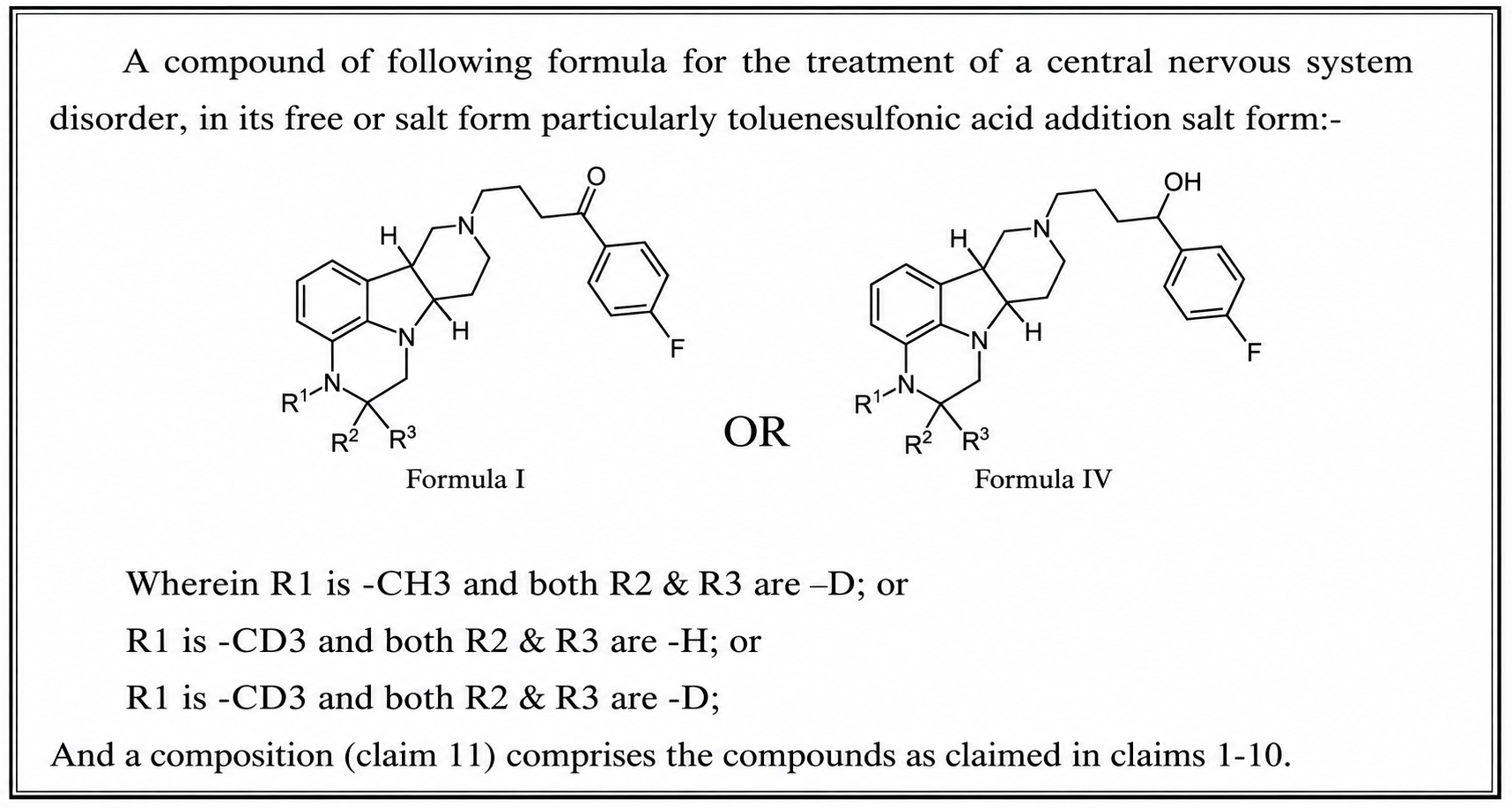 The Controller rejected this Indian Patent Application No. 201817033732 on three grounds: lack of novelty under Section 2(1)(j), lack of inventive step under Section 2(1)(ja), and non-patentability under Section 3(d).
On novelty, the Controller relied principally on prior-art documents D1 and D7, concluding that the claimed deuterated compounds were already disclosed in those documents. On inventive step, the Controller relied on D4–D6, which disclosed the general principle of using deuterated alternatives of known drugs. It considered that, when these teachings were read together with D1 and/or D7, it would have been obvious to a skilled person to arrive at the claimed compounds.
The Controller also invoked Section 3(d), treating the claimed compounds as new forms of known substances. However, the reasoning essentially proceeded on the basis that the compounds were already disclosed in D1 and D7, rather than separately identifying the relevant known substance.
Aggrieved by the rejection order, Intra-Cellular Therapies appealed to the Delhi High Court under Section 117A of the Patents Act. The Intra-Cellular Therapies v Controller of Patents decision therefore provides useful guidance on the distinct patentability issues arising under the Patents Act.
Issues before the Court
- Whether the claimed invention indeed lacked novelty under Section 2(1)(j), despite not being directly and unambiguously disclosed in D1 and D7, and whether arriving at the claimed compounds required multiple selections from broader disclosures?
- Whether the claimed invention lacked inventive step under Section 2(1)(ja) in view of the alleged combination of D1/D7 with D4–D6, and whether a skilled person would have been motivated to arrive at the claimed invention?
- Whether the claimed compounds were excluded from patentability under Section 3(d) on the ground that they constituted new forms of a known substance?
Court’s Analysis
Novelty Under Section 2(1)(j)
The Court upheld the Controller’s judgement of lack of novelty.
The relevant prior-art documents disclosed the structural features of the compounds claimed in the application. Selecting the substituents disclosed in D1 (Example 1.21) yielded the compound of Formula IV, while selecting the substituents disclosed in D7 yielded Formula I–III.
The appellant’s principal defense was that multiple selections were necessary from the disclosures before the claimed compounds could be reached. However, the Court did not rejected this defence. Relying on AstraZeneca AB v. Intas Pharmaceuticals Ltd. [2021 SCC OnLine Del 3746] and Boehringer Ingelheim v. Vee Excel [CS(COMM) 239/2019 & CCP(O) 82/2019], the Court held that because the inventors of D1 and D7 and of the present application were the same, the anticipation test had to be applied from the standpoint of the “person in the know” rather than the ordinarily skilled person — meaning that once a compound is disclosed under an earlier genus disclosure by the same inventors, the absence of an express, standalone disclosure of the specific compound does not, by itself, preserve novelty. The Court consequently held that the relevant claims lacked novelty under Section 2(1)(j).
The Intra-Cellular Therapies patent case also highlights the importance of examining the scope of prior-art disclosures when assessing the novelty of pharmaceutical compounds.
Inventive Step Under Section 2(1)(ja)
The appellant argued that the Controller had effectively relied upon a combination of prior-art documents without explaining the technical reasoning or motivation that would lead a skilled person to make the claimed modification. According to the appellant, simply identifying a general teaching concerning deuterated compounds could not establish that the specific claimed invention was obvious.
The appellant relied on the principles stated in F. Hoffmann-La Roche v. Cipla [148(2008)DLT598] and Agriboard International v. Deputy Controller of Patents and Designs [C.A. (COMM.IPD-PAT) 4/2022], submitting that an inventive-step analysis must demonstrate the route by which a skilled person would move from existing knowledge to the claimed invention.
Significantly, however, the High Court did not finally determine the inventive-step issue. Since the Court had already upheld the rejection of the patent on the grounds of lack of novelty under Section 2(1)(j) and non-patentability under Section 3(d), it considered it unnecessary to examine the objection under Section 2(1)(ja).
Non-Patentability under Section 3(d)
The appellant relied on experimental and pharmacokinetic evidence to demonstrate improvements associated with the claimed compounds, including increased bioavailability and changes in metabolic behavior. It argued that these results constituted a meaningful improvement over the known compound. This aspect is particularly relevant when considering deuterated compounds Section 3(d), where improvements in pharmacokinetic properties may be relied upon in support of patentability.
The Court, however, emphasized that improved bioavailability cannot automatically be equated with enhanced therapeutic efficacy. Relying upon the Supreme Court’s decision in Novartis AG v. Union of India (AIR 2013 SC 1311), the Court reiterated that “efficacy” under Section 3(d) depends upon the function and purpose of the product. In the case of medicines, the relevant standard is therapeutic efficacy, which must be interpreted strictly. Not every advantageous property of a pharmaceutical product is relevant for Section 3(d); the improvement must relate directly to efficacy.
The Court also relied upon Natco Pharma vs. Novartis AG & Anr., FAO(OS) (COMM) 178/2021, decision dated 24.04.2024 which reaffirmed that enhanced bioavailability is not synonymous with enhanced therapeutic efficacy. Where increased bioavailability is relied upon, the patentee must establish through research and data that the improvement actually translates into a therapeutic benefit.
The appellant had also placed additional evidence before the Patent Office through the co-inventor’s affidavit. The High Court considered this evidence despite the appellant’s contention that it had not been considered by the Controller and found that the evidence demonstrated changes in metabolic behavior and pharmacological characteristics. However, it did not establish that these changes resulted in enhanced therapeutic efficacy. The Court drew a clear distinction between demonstrating that a compound has improved pharmacokinetic or pharmacological characteristics and demonstrating that it provides a superior therapeutic outcome. Accordingly, the Court held that the evidence did not meet the requirements of Section 3(d).
Our Analysis and Conclusion
Intra-Cellular Therapies (supra) underscores the distinct statutory thresholds for novelty, inventive step and Section 3(d) in pharmaceutical patent examination. The Intra-Cellular Therapies v Controller of Patents decision therefore provides useful guidance on the separate requirements applicable to pharmaceutical patentability.
On novelty, the Court’s approach confirms that the absence of an express disclosure of the precise claimed compound does not necessarily preserve novelty where the prior-art disclosure, read as a whole, encompasses the claimed subject matter. Broad structural disclosures therefore require careful analysis before concluding that a later compound is novel.
On Section 3(d), the Court emphasized that improved bioavailability, metabolic stability or pharmacokinetic characteristics do not, by themselves, establish enhanced therapeutic efficacy. The applicant must demonstrate a credible relationship between the identified improvement and a therapeutic benefit. Thus, evidence showing altered drug metabolism or exposure may be scientifically significant but remains insufficient under Section 3(d) unless it translates into enhanced therapeutic efficacy. This distinction is particularly important for deuterated compounds Section 3(d), where the nature of the demonstrated improvement must be carefully assessed against the statutory requirement of enhanced therapeutic efficacy.
The decision therefore has important implications for pharmaceutical patent strategy. Applicants must undertake a rigorous analysis of the structural scope of the prior art and, where Section 3(d) applies, support the claimed advantage with evidence directed to therapeutic efficacy rather than merely improved pharmacokinetic properties. The Delhi High Court Section 3(d) 2026 decision reinforces the importance of this distinction when assessing pharmaceutical inventions involving modifications of known compounds.