
Introduction
The scope of Section 3(m) Patents Act has remained one of the least explored aspects of Indian patent law. While courts and the Patent Office have extensively interpreted provisions such as Section 3(k) relating to computer programs and algorithms, Section 3(m), which excludes a mere scheme or rule or method of performing mental act or method of playing game from patentability in India, has rarely received detailed judicial consideration. This lack of guidance often results in inconsistent objections during patent examination, particularly for process-based and computer-implemented inventions involving a possible mental act patent India objection.
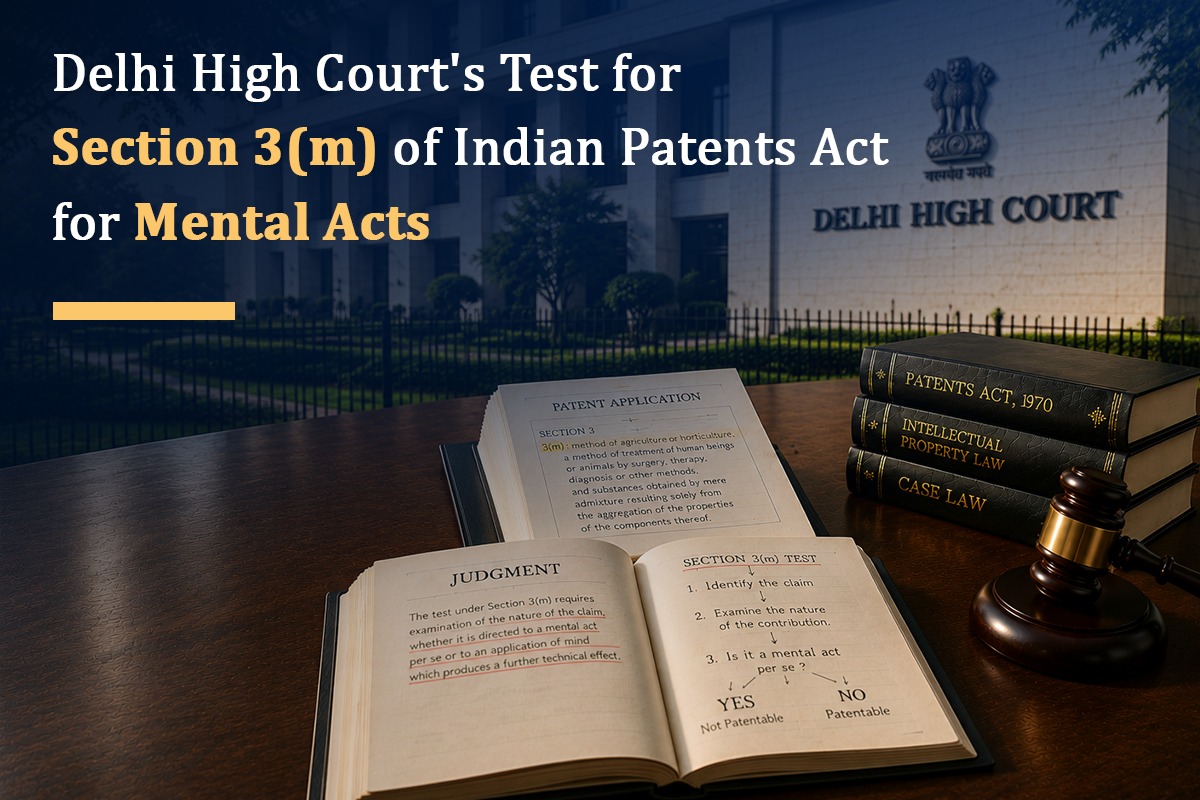
The Delhi High Court has now addressed this uncertainty in T-Mobile International AG & Co. KG. v. Controller General of Patents, Designs and Trademarks1, where it formulated India’s first structured framework for examining objections under Section 3(m). Recognizing the absence of examination standards, the Delhi High Court Section 3(m) ruling framed a seven-step test that is expected to guide both patent examiners and applicants in determining whether a claimed invention merely monopolizes a mental act or qualifies as a patent-eligible invention.
Understanding Section 3(m)
Section 3(m) excludes patentability “a mere scheme or rule or method of performing mental acts or method of playing games.” The Court clarified that the provision creates four distinct exclusions: (i) a mere scheme, (ii) a mere rule, (iii) a mere method of performing a mental act, and (iv) a method of playing a game. Importantly, the adjective “mere” qualifies the first three categories, indicating that the exclusion applies only where the claim is directed solely to an abstract mental activity and nothing more.
The Court further explained that mental acts encompass activities such as reasoning, calculation, evaluation, judgment, cognition, and logical thinking. Unlike novelty or inventiveness, which examine the technical merits of an invention, Section 3(m) focuses exclusively on the nature of the claimed monopoly and whether it is, in substance, a mental act patent India claim. Thus, an invention may satisfy all traditional requirements for patentability in India and still be excluded if it merely seeks protection over a mental process. The Court emphasized that this inquiry must remain independent of novelty and inventiveness analyses.
The Seven-Step Test under Section 3(m)
- Construe each claim in light of the specification from the perspective of a person skilled in the art, while avoiding the importation of limitations from the specification into the claims themselves. The focus must remain on what the claims cover rather than on the broader disclosure.
- Genuine product claims, such as apparatus or device claims defined by their physical characteristics, are not “schemes, rules or methods” and therefore cannot ordinarily be rejected under Section 3(m). The provision primarily concerns process, or method of claims rather than tangible products.
- Identify what the claim, when read as a whole, monopolizes. The Court cautioned examiners against dissecting a claim into isolated elements and rejecting it merely because one individual step involves reasoning or calculation. Patent protection extends to the claim as an integrated whole, and the Section 3(m) analysis must adopt the same holistic approach.
- Ask whether the monopoly sought amounts to nothing more than a mental act. The Court introduced a practical test: if the claim can be infringed simply by a person’s thinking, reasoning, calculating, judging or deciding, then it monopolizes a mental act and is excluded from patentability. However, Section 3(m) Patents Act is not attracted where the claim, considered as a whole, requires physical means integral to its performance, involves interaction between hardware and software to achieve a practical result, or produces a tangible output.
- Merely adding post-solution activities such as displaying, presenting or printing information does not transform an otherwise excluded mental process into patentable subject matter. The physical component must be integral to carrying out the claimed method rather than serving as a token addition after the mental exercise has already been completed. This fifth step addresses attempts to overcome the exclusion through insignificant physical additions.
- Whether a claim is innovative or obvious has no bearing on whether it monopolizes a mental act. Accordingly, the examiner must avoid conflating patent eligibility under Section 3(m) with the separate requirements contained in Sections 2(1)(j) and 2(1) (ja). This sixth step reinforces that Section 3(m) is entirely distinct from novelty and inventive steps.
- Where a claimed invention is implemented through a computer or computer program, it should not automatically be rejected as a mental act. Instead, the claim must be separately examined under Section 3(k), since the two provisions operate independently and address different categories of excluded subject matter. Thus, the seventh step distinguishes Section 3(m) from Section 3(k).
Illustrations Provided by the Court
The judgment strengthens the seven-step framework through practical illustrations. A method of solving a Sudoku puzzle entirely through logical deduction was held to be excluded because the claim could be performed solely by thinking. Likewise, merely adding the step of printing the solution does not remove the claim from the exclusion, as printing is only a token of post-solution activity.
Conversely, methods involving sensors, engine control units, heating devices or signal-processing hardware were held to fall outside Section 3(m) because they require physical implementation and produce tangible technical outcomes. Similarly, computer-implemented methods that necessarily require a computer are not automatically excluded under Section 3(m); instead, they should be examined under Section 3(k). These illustrations demonstrate that the decisive question in any Delhi High Court Section 3(m) analysis is not whether mental reasoning forms part of the invention, but whether the monopoly ultimately extends beyond the realm of abstract thought.
Significance of the Judgment and Conclusion
The decision represents a significant development in Indian patent jurisprudence. For the first time, the Delhi High Court has provided a structured and predictable methodology for applying Section 3(m), reducing the likelihood of arbitrary or inconsistent objections by patent examiners. The judgment also aligns Indian practice with persuasive European jurisprudence by emphasizing that technical implementation and tangible physical effects generally place an invention outside the scope of the mental act exclusion. For applicants considering patentability in India, the ruling provides a clearer basis for distinguishing genuine technical inventions from excluded abstract mental processes.
The Delhi High Court’s decision in T-Mobile International AG (supra) marks a turning point in the interpretation and application of Section 3(m) Patents Act. By introducing a clear seven-step test, the Court has shifted the focus from isolated mental processes to the true scope of the monopoly claimed. From a practical perspective, the Delhi High Court Section 3(m) ruling offers valuable guidance for patent applicants, particularly those working in software, artificial intelligence, and computer-implemented technologies. Applicants can now draft claims with greater certainty by ensuring that physical means, technical implementation or tangible outputs form an integral part of the claimed invention rather than being introduced merely as nominal additions, thereby reducing the risk of a mental act patent India rejection.